Lives In Isolation: Reflections on the Coronavirus

With all the Coronavirus hub-bub these days everywhere, I was recently asked about a social media post citing the Bible verse from 2 Chronicles where God punished the sins of Israel through plagues, locusts, etc. These calamities were all in an attempt to bring God’s people to repentance. No, I don’t buy the idea that it’s God’s plan to use the Coronavirus as a catalyst for worldwide repentance. Just in the same way that I don’t believe it is God’s will for us to watch Cancer ravish the lives of our loved ones.

We do live in a world that is detached from God, a “war-zone” if you will.  It is a world of physical disease and diseases of the soul such as greed.  In this war-zone, we are now in the midst of another pandemic, the likes of which seems to emerge once every one hundred years or so.  So rather than view the current pandemic as a global call to repent, I see it rather as another symptom resulting from our detachment from God.  The virus is a part of this world that is not of our Lord, but rather a byproduct of our fallen condition.   For inspiration during these challenging times, I opt to examine other people throughout our collective human experience that have lived lives in isolation.

In all of this I like to remember the historical and biblical characters who lived their lives in much worse isolation.   As my wife was cleaning her closet on day two, she came across the “Diary of Anne Frank.”  What an appropriate person to reexamine during our current time period.   Anne was 13 when she was forced into hiding.  Our situation pales in comparison.  She couldn’t go outside, or open the window for fresh air.  She often had to remain silent for periods of time.  Yet she endured and even found moments of happiness and some satisfaction in an unreasonable living situation.

On to the Bible. Noah, now there is a fella with some cramped living arrangements. Not only was he limited to interactions with a small group of family members, he was sharing the space with a whole bunch of animals. Basically, this lucky fellow found himself in a floating zoo for 40 days and 40 nights. The smell must have been magnificent.

Just when you thought it couldn’t get any worse than Noah, there is Jonah.  Yes, Jonah’s duration was much shorter than Noah and Anne Frank (3 days and 3 nights) But how uncomfortable must he have been to be in the mouth of a “big fish?”  If I had to pick one of these, I don’t which one I would choose to suffer through, but I will say I would rather endure our current dilemma, no doubt about it.

Finally there is Jesus.  He went to the desert in isolation really only accompanied by Satan, not exactly great company.   Our Lord spent 40 days without food or human contact.  So now, not only was he not talking to anyone, Satan was there to tempt Jesus while he was physically weak, not once but three times.  The temptations seem to resemble a morbid type of teasing….starving, well here is some food to alleviate your suffering.  Only the Son of God could suffer and overcome such tremendous isolation and temptation.

Our current crisis will pass, it is not unique to the human experience.  For strength I will continue to consider those before me that have traveled a similar road, while praying to Our Lord Jesus, and of course repenting every day just in case 🙂

-Got any other examples?  Feel free to comment….

LuHi Football: A bigger message

There is an elephant in the room. The elephant is that football is a dangerous sport and that kids shouldn’t play it. I concede football is not the safest sport, but I will say…..it has never been a safer sport than it is right now with better equipment, new rule changes, and a better understanding of concussion symptoms.  Football is no stranger to rule changes as the game was historically under the microscope for its brutality. In 1905, Teddy Roosevelt met with college presidents at the White House to discuss the game, because its brutality was reaching some unacceptable levels.  As a result of this meeting and other discussions, the forward pass was invented along with the new position of wide receiver which spread the game out drastically. We are currently at another one of these historical paradigm shifts with the game of football, as helmet to helmet contact is now further restricted by modern rule changes, all in an effort to make the game safer and acceptable.

Here at LuHi our coaching staff and players are adjusting to these new rule changes while preparing for our upcoming season. There is some excitement in the air as LuHi will begin the fall of 2019 competing in the Metropolitan Independent Football League (MIFL).  This is a league full of not just good football teams, but excellent academic schools. Last year the champion was Rye Country Day School, which represents both of these attributes. As a member of this new league, LuHi has also been selected to take part in a football/concussion study which may eventually lead to further rule changes, as our league is a pioneer in this cutting edge study.  We are excited to be a part of the MIFL and to take part in this study, which will blaze the trail for changes that will make football much safer.


This summer our program had the opportunity to compete in a 7 on 7 tournament hosted by our new league.  LuHi ended the tournament as champions, defeating Hackley in the semis and Morristown-Beard (NJ) in the final. As a result, there are no secrets: LuHi has some folks that can play football.
While we are excited about the opportunities moving forward, the bigger questions are – Why should people play football? and What do I want our players to take away from their LuHi football experience?  

Like many sports, playing football has many life lessons, some of which are GREATLY emphasized.  One player can’t dominate a football field. It is an 11 on 11 game and as such TEAMWORK is developed to the greatest of extents.  A Division I quarterback can’t be effective if they are not protected by the well-orchestrated protection efforts of the offensive line in front of them.  This scenario can be created for any position on the football field. Football is an incredibly technical game where the collective efforts of the team far outweigh any individual talent or effort.

As a coach, one of my missions for our program is to develop this emphasis on teamwork into a community – one that supports one another but also looks to extend this support to our greater Long Island community.  I want our players to take away an understanding that life is bigger than football and to use some of the lessons they have learned to serve their community.  Last year, we had a group of our players volunteer to help an organization set up their homeless shelter at Ascension Lutheran Church in Deer Park. We worked as a team to transform a church gymnasium into a functioning shelter in the dead of winter.  I want our players to take away the command of Jesus to “Love our neighbors as ourselves” and for them to understand that everyone is made equal in the image of God and as such we need to empathize and treat all people with respect. Setting up the shelter, and the interactions we had with some of the people staying there, really helped deliver these messages outside of the football field.

While the game of football teaches us valuable life lessons, like toughness and accountability, I believe teamwork is one of the more important lessons.  It is my hope and prayer that our players take these lessons and continue to extend them into their communities.
By: Chris Reno – 7/24/19

Failing Successfully Part II

As a teacher, coach, and now an administrator, I have witnessed many students experience disappointment in the face of failure. Of course, it is natural to feel discouraged when we fall short. The typical mindset is: We prepared, studied, collaborated, and practiced—all in vain. But when failure occurs, I find myself asking: Am I holding myself accountable for this temporary setback? Did I truly prepare adequately? Was all that preparation really for nothing?

It’s easy to pass the buck. In our daily routines, we encounter countless obstacles that can stand in the way of reaching our goals. The temptation to blame these obstacles for our shortcomings is strong. However, if we want to move forward productively, we must confront this mindset and acknowledge that we are often the primary factor in our own failures. As human beings, we appreciate being recognized for our successes, but we tend to downplay our role in our failures.

The truth is, success stems from personal initiative—but it is also deeply influenced by the support we receive from others. Personally, I am only successful because I’m surrounded by a gifted faculty and staff. Their excellence ensures that I can do my job effectively, as long as I take responsibility and lead with intention. In our middle school, when a student experiences a temporary lapse in success, I first ask them to reflect on their own actions. Then, I encourage them to identify the people around them who can support their journey back to success.

After we evaluate our role in a failure, the next step is to ask ourselves: What did I actually do to prepare? Honest self-reflection often brings clarity. More often than not, a lack of proper preparation emerges as a major cause of failure.

This brings me to a personal story—one I’m always hesitant to share—but I think it’s relevant. During college, I studied hard for my first chemistry quiz. I walked into the lecture hall feeling confident. A few days later, that confidence evaporated when I saw my score: 37%, if I remember correctly. I could have blamed the distractions of college life—there were plenty—but instead, I chose to self-reflect. I accepted responsibility and realized my preparation had been inadequate. That very day, I went to the library and signed up for free tutoring services. The story has a happy ending: I went on to earn an “A” in the course.

I also came to an important realization: although I “earned” that grade, my success was not mine alone. It was made possible by the help and support of others.

So, was all my initial preparation in vain? Absolutely not. Even though I failed that quiz, the experience became a catalyst for growth. That failure sparked my decision to take responsibility, re-evaluate my efforts, and seek support. Eventually, that process led me to success.

Students need to understand that failure is temporary. When we take the time to examine it closely, we often discover that failure is not the end—it’s the beginning. Within every setback lies the seed of future success.

Failing Successfully

Image result for failure success

This morning, I was listening to a podcast sermon, and I thought the topic was perfect for our students and their families. In truth, the message applies to everyone: “Do not be afraid of failure.”

The speaker discussed how fear of failure has reached epidemic levels among children—something we can clearly see mirrored in the adult world. Fortunately, failure is a natural part of life.

Consider the apostle Peter, one of the most influential disciples. It was Peter to whom Jesus said, “You are Peter, and on this rock I will build my church” (Matthew 16:18). Yet this same trusted disciple famously failed—denying Christ not once, but three times (John 18:15–27). In many ways, Peter reflects the human condition: one moment deeply faithful, the next filled with doubt. Despite his failure, Peter ultimately became the rock upon which the Church was built.

The same message can be found in the secular world. Jeff Bezos, CEO of Amazon, has said that when he looks back on his life, it won’t be his failures he regrets—it will be the opportunities he didn’t take because he was afraid to fail.

We must remember: nothing worthwhile comes easily. We can’t be afraid to apply ourselves fully to our efforts. For students especially, it’s often easier to accept failure on a test they didn’t prepare for than to face the disappointment of a poor result after studying hard. But I encourage our students to give their best. If the outcome is still disappointing, that moment becomes a valuable learning opportunity.

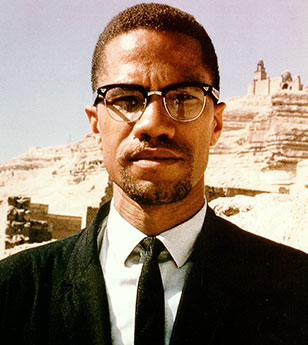
Malcolm X


Malcolm X


February is Black History Month, and I would be remiss if I didn’t take the opportunity to publicly acknowledge my all-time favorite civil rights leader. I first got to know who Malcolm X was through Alex Haley’s biography, and later through the film adaptation directed by Spike Lee. As a younger, testosterone-fueled football player, I found myself identifying more with Malcolm’s aggressive approach to civil rights, especially in contrast to the peaceful Satyagraha methods championed by Dr. Martin Luther King Jr.

But what I truly came to appreciate was the transformation of Malcolm X. I’ve always been drawn to stories of personal growth and the evolution of human character—and that’s exactly what you see in Malcolm’s life. His persona changed significantly over time. He was a burglar, then a prisoner, then a devout Muslim who preached separatism, and finally someone who came to see the beauty in all races and began preaching racial reconciliation.

Too often, we remember only the fiery rhetoric of Malcolm X and forget that his message had evolved by the time of his tragic assassination.

Malcolm converted to Islam during his time in prison, and upon his release, quickly rose through the ranks to become a leader in the Nation of Islam here in the United States. His first transformation was from a burglar to a devout Muslim leader who took an extreme stance on civil rights. His second transformation came during his pilgrimage to Mecca, where he prayed alongside Muslims of many races and realized that racial harmony was indeed possible.

The human character is a fascinating thing. We must remember that we can grow, change, and become enlightened as we continue through life, learning from those around us. This is what some psychologists refer to as a “growth mindset.” That’s exactly what happened to Malcolm. His story is a powerful testimony to the transformative power of love—something that can change all of us for the better.

So during the month of February, I choose to remember Malcolm X not only for his passionate voice and powerful rhetoric, but also for the transformation of his spirit, which ultimately led him to believe that racial reconciliation was possible.

Identity Crisis: Reflections and Recommendations for the Republican Party (pre-MAGA meandering)

Reflections on the Republican Party’s Coalition and Future Direction

In our two-party system, both major parties strive to build a broad coalition of voters to carry them to victory in local, state, and national elections. The Republican Party dominated not only my hometown and state growing up but much of the surrounding region as well. While political strategists on both sides may advocate for their parties to shift further left or right, I’d like to see the Republican Party preserve the ideals I grew up with while moving more toward the center. I’m not a political scientist—this is simply a personal reflection on the GOP’s constituent base, with a few bold policy suggestions for the future.

I grew up in a western state nestled in the beautiful Rocky Mountains. The region fostered a culture of independence. We started driving at a young age—15 or 16—and with that freedom came road trips, camping excursions, and outdoor adventures, often without adult supervision. This spirit of independence also shaped our politics. The Republican Party, in particular, nurtured that mindset by championing land and gun rights.

In many western states, zoning and gun laws are notably relaxed. For example, I legally purchased my first firearm—a .45 caliber pistol—at a store called Rocky Mountain Sports and Liquor, which even featured a drive-thru window. That anecdote alone says a lot about local regulations and cultural norms.

People in the West often feel a deep connection to the land—not just as a sacred and beautiful landscape, but as privately owned terrain that must be protected from federal overreach. The GOP’s defense of private property rights, low taxes, and local control resonated strongly. Many western landowners have long contested the federal government’s control of land—often 25% to 65% of a state’s total area. In many ways, the federal government functions like a landlord, a dynamic that creates tension. The GOP built support by defending gun rights and representing the “independent” landowner against what was perceived as a bloated, intrusive federal government. Agencies like the EPA, Department of the Interior, Department of Agriculture, and ATF became convenient targets for blame—sometimes rightly so. Consider the federal overreach in cases like Ruby Ridge or Waco, Texas.

Another key pillar of the GOP base has been religious social conservatives. In my home state, this group largely comprised Evangelicals and Mormons. Evangelicals, in particular, became a cornerstone of the national Republican base, drawn by the party’s strong stances on issues like abortion and same-sex marriage. This formula contributed to Republican dominance in the West and helped elect George W. Bush and his running mate, Dick Cheney of Wyoming. Bush, a born-again Christian, embodied the religious appeal, while Cheney personified western values.

The strength of the Evangelical vote was evident again in 2004. Karl Rove, Bush’s campaign strategist, made a deliberate effort to mobilize these voters—not just to the polls, but into campaign operations as volunteers. Their overwhelming support played a major role in Bush’s reelection.

Rounding out the Republican base is a pro-business, economically conservative faction—Wall Street advocates, millionaires, small business owners, and financially conscientious middle-class voters. These are the Republicans I’ve come to know while living on the East Coast. In contrast to many social conservatives, this group tends to be more socially libertarian. They may support same-sex marriage, for instance, as long as the couple pays taxes—and preferably low ones. The Bush/Cheney ticket and even Trump’s campaign appealed to these voters by emphasizing tax cuts and deregulation. Additionally, the national GOP base includes Libertarian-leaning individuals, who maintain a particularly strong presence in the West.

Now that I’ve outlined what I see as the key factions within the GOP, I believe the time has come for the party to reevaluate its platform. Moving forward, the GOP would be wise to prioritize equal rights while continuing to protect the religious freedoms of churches and other faith-based institutions. Though this may seem like a subtle shift, it would represent a bold break from recent party orthodoxy and would likely alienate part of the traditional base.

First and foremost, the GOP should stop opposing same-sex marriage and gay adoption. Instead, it should embrace a platform of equal legal rights. From an economically conservative standpoint, promoting marriage—regardless of the couple’s gender—can lead to more financially stable families. Stable families are less dependent on state assistance, and larger adoption pools mean fewer children relying on government welfare. Sociologically, the family remains the cornerstone of a stable society. If the GOP continues to champion the family unit, it should not seek to narrowly define what constitutes a family. Admittedly, this stance would be controversial among Evangelicals, but the greater challenge for socially conservative voters lies ahead: protecting their right to practice their faith freely.

The GOP already supports religious liberty and the protection of nonprofit status for faith-based institutions. The party rightly recognizes the value these organizations bring to their communities—even when they object to certain federal mandates. The party’s defense of religious freedom must remain central to its platform. Doing so will help retain the support of Evangelicals, Catholics, Mormons, and others.

Today’s pressing cultural conflict is no longer same-sex marriage or abortion—those battles are largely settled in the legal and social arenas. The current front is about the rights of religious institutions. For example, Catholic hospitals should not be forced to provide abortions or birth control if doing so violates their religious beliefs. Denying them federal funding on that basis would harm the communities they serve. Protecting their autonomy is a critical issue that resonates with a broad swath of religious voters.

Ultimately, the Republican Party should not abandon the culture war—but rather, it should redefine it. Roe v. Wade and Obergefell v. Hodges are settled law. Our culture is becoming increasingly liberal, and the GOP must evolve in response. The party should remain committed to smaller government and personal liberty—liberty and equality for all. A truly small government doesn’t belong in your bedroom.

If the GOP clings to an outdated platform, it risks both political irrelevance and being remembered as a party on the wrong side of history.


Further Reading:

Note: The views expressed in this blog do not necessarily reflect my personal or religious beliefs. They are presented here as reflections on the Republican Party’s current coalition and suggestions for its political future.


Let me know if you’d like this reformatted into a blog post or visual piece for publication or social sharing.

A Lesson on Selfishness: The Ultimate Virus

stomach-virus-creature

Every Sunday evening, my wife and I sit down to go over the upcoming week. You know, the kind of discussion where we figure out who has evening meetings, who’s picking up the kid, and when we’re having dinner. We’re basically trying to coordinate the week in a vain attempt to provide some structure and order to our lives.

Kelly was preparing for a business trip to Florida (yes, an actual beach resort) for a conference and would be gone from Wednesday through Saturday night. I knew this trip had been on the calendar for quite some time, and while I was admittedly a bit jealous, I felt mentally prepared.

What I hadn’t realized was that my own schedule was jam-packed. I had work obligations every single day that week—seven days straight. That’s when the frustration hit: I realized my sacred weekend downtime had vanished. In that moment, I vented to Kelly—thinking and saying things like: You have to go on a business trip during the busiest week of my calendar? My business trips are never this long. How am I supposed to meet all my work obligations and take care of our daughter? And most importantly… I need my weekend! When is that supposed to happen??

Of course, none of this was her fault. And by this point in our marriage, Kelly understood this was just my irrational way of blowing off steam. It didn’t take long for me to recognize the immaturity of my reaction and my lack of composure in the face of adversity (Titus 2:2). I eventually calmed down, refocused, and said all the right surface-level things while quietly trying to figure out how to manage my complicated week.

With no immediate family nearby, Kelly had already lined up a couple of friends to be on standby during her trip (yeah, she’s that good). Knowing I had some reinforcements on the sidelines gave me a bit of peace.

Wednesday morning arrived, and Kelly was out the door by 5 a.m. I was ready to take on the challenge. I got up, saw her off, made breakfast, woke up the kid, packed lunch, and we were out the door on time for school and work. At the end of the day, I picked up the kid, made dinner, and we were home by 5:30 p.m. Day one—conquered like clockwork.

Thursday followed a similar pattern. On my way out of work, a few teammates on my admin staff jokingly threw jabs like, “Being a mom isn’t so easy,” and “Now you see how much Kelly juggles.” I chuckled and acknowledged their points, but honestly? Things were going smoothly. Dare I say… motherhood is overrated?

Thursday ended just like Wednesday—flawless execution (Proverbs 19:21). That evening, my daughter and I even went out to eat and made it home in time to walk the dogs. Not only were we executing the week with near perfection—we were even keeping up with the dogs. What a week indeed! (Daniel 4:4)

But all of this was short-lived. Everything changed drastically in the wee hours of Friday morning—1 a.m., to be exact.

If you’re a parent, you know the sounds I’m talking about. You wake up suddenly, hearing your child bolt out of bed and sprint to the bathroom. And I don’t need to describe the next sound I heard once she got there.

I tried not to panic, but it was clear—my daughter had a stomach virus. From 1 a.m. to 4 a.m., this awful cycle repeated every 30 minutes. To make a long story short, the worst of the storm lasted until 10 a.m. My new routine became: hold her hair back, wait it out, get her back in bed, and clean… clean… clean.

Once things settled a bit, my thoughts immediately turned to work. There was no way I’d be making it in that morning, so I sent an email to my team to let them know I’d be out.

By 11 a.m., peace returned—a true Pax Romana. I was exhausted, but my daughter seemed to be on the mend, which brought a sense of calm. My admin team had been informed, responded with sympathy, and even suggested a few remedies. I had reached out to Kelly as well—more than once—and, being Kelly, she had already arranged for a friend to stop by with reinforcements: Lysol, bleach spray, Saltines, ginger ale, and a bottle of Coke. Now that was a brave friend.

Meanwhile, back at work, things were busy—really busy. Guilt started creeping in. Believe it or not, I actually enjoy what I do and feel a strong sense of obligation. Still, I reminded myself: my daughter’s health came first. I was able to manage the guilt—but what I hadn’t handled well was my communication with Kelly. I wasn’t always positive. Every now and then, old jealousy crept in, and I’d send a passive-aggressive text.

Images of her enjoying her professional conference—at a beach resort, no less—haunted me (1 Samuel 18:8). Meanwhile, I was bleaching bathrooms, washing sheets, and coaxing my daughter to sip ginger ale. And then, I had what alcoholics might call a moment of clarity.

This wasn’t the first stomach virus my daughter had ever had. So… where was I during all the other ones? Oh right—I wasn’t the one doing this. I’m not the mom.

Forgive me, Lord, for I have sinned. Motherhood is definitely not overrated.

This whole ordeal reminded me of just how much Kelly does for our family. I only stepped into her role for a few days, and it left me drained. I made a point to tell Kelly how much I appreciated her—as a wife, as a mother, and as my partner.

During our conversation, she made a powerful observation. At the end of it all, after I’d missed work Friday and Saturday, she said:
“In a weird way, our daughter helped you get your weekend back.”

She was right. I had whined and complained about losing my weekend at the start of all this—and in the end, I got it back. But not without lessons learned.

The Lord, in His wisdom, seemed to be saying, “Sure, you can have your precious weekend… but there will be lessons to learn.” (Proverbs 3:11–12)


Scripture References (ESV):

Titus 2:2Older men are to be sober-minded, dignified, self-controlled, sound in faith, in love, and in steadfastness.
Proverbs 19:21Many are the plans in the mind of a man, but it is the purpose of the Lord that will stand.
Daniel 4:4I, Nebuchadnezzar, was at ease in my house and prospering in my palace.
1 Samuel 18:8And Saul was very angry… “They have ascribed to David ten thousands, and to me they have ascribed thousands. What more can he have but the kingdom?”
Proverbs 3:11–12My son, do not despise the Lord’s discipline or be weary of His reproof, for the Lord reproves him whom He loves, as a father the son in whom he delights.

If everyone is super…then no one is.

The Incredibles

Having a younger daughter basically means my wife and I have seen every animated cartoon movie known to man. Honestly, we even find ourselves quoting animated movie lines during adult conversations—which can be a little embarrassing. Of course, I’m about to quote yet another cartoon movie, but only because the line really resonated with me.

The movie was The Incredibles, and the line came during a scene where the villain—like all villains do—took the time to explain his evil plan to Mr. Incredible. His scheme was to make everyone a “superhero” using his gadgets and gizmos, and in doing so, he said:
“When everyone’s super… no one will be.”

I’d like to connect that animated gem to something both personal and professional.

My daughter used to be in a baton twirling group. Yes, I’ll admit, I was surprised to learn that baton twirling is still a thing. But apparently, it is—and it even comes with the possibility of earning scholarship money for college. Who knew?

I remember her big competition one year. The parents were all gathered with their camera phones, the girls were in glitzy outfits, and loud music cued the routines on the gym floor. Then, off in the corner, there it was: a big table proudly supporting hundreds of trophies. And at the end of the day, each participant, of course, received a gigantic trophy simply for being part of the program.

While being part of a program is great, what we should really be celebrating is being an exceptional part of the program. Participation trophies, though well-meaning in their attempt to foster self-esteem, can sometimes have the opposite effect. Even kids can sense when an award doesn’t represent genuine achievement.

Which brings me to self-esteem.

All of us—whether parents, guardians, grandparents, teachers, or mentors—want our children to grow into confident individuals who believe in themselves and their abilities. But what we really need to build in them is what I call authentic confidence, because self-esteem can be fleeting.

Even as adults, we have days when we feel on top of our game—we have the answers, others seek our input, and everything flows. Then there are days when we feel drained or unsure if we even deserve our title or position, as if we’ve somehow lost the ability to move forward. That’s because self-esteem fluctuates—it can shift by the day, or even by the hour.

But authentic confidence is different. It doesn’t fade because it’s built on integrity, honesty, and hard work. It’s earned. And because it’s earned, it sticks with us—even on the days when our self-esteem wavers. With perseverance and character, we can weather the natural ups and downs of how we feel about ourselves.

When we choose to recognize only the average—or reward everyone the same just for participating—we unintentionally do a disservice to those who invested extra time, worked harder, or are exceptionally gifted. Don’t get me wrong—participating in sports, clubs, and other activities is valuable and should absolutely be acknowledged. But not everyone is the club president, the MVP, or on the Honor Roll.

Because after all, if everyone is super… then no one is.

Immigration: The same but different (a true you Yogi-ism)

1892 immigration

“The culture of poverty has some universal characteristics which transcend regional, rural-urban, and even national differences…..

-Oscar Lewis, “The Culture of Poverty” in Four Horseman

The United States has always been a nation of immigrants. Consider the Irish in the 1840s, who fled starvation and, by the 1860s, welcomed the Civil War as a job opportunity—guaranteed meals and a roof over their heads. Whether it was Italians, Scandinavians, the English, or the Scottish—let’s face it, these newcomers were not “European nobility” by any stretch of the imagination. Immigrants were struggling, often impoverished.

Now, we are faced with what many are calling an “immigration crisis.” Numerous immigrants are arriving from our southern border, and they are coming for the same reasons immigrants have always come to America: opportunity.

Many are motivated by the strength of the American dollar. In several Latin American countries, U.S. dollars—primarily through remittances—account for up to 15% of national GDP (Pew Research, 2013). These immigrants actually provide a kind of weapon against inflation. The dollar has remained strong in part because of them, coinciding with a decrease in American wages as a share of total GDP (New York Times, 2013).

This economic squeeze on the blue-collar middle class—while painful—has helped restrain inflation. Immigrants contribute by sending American dollars outside our borders, effectively reducing the domestic money supply and helping preserve the value of the dollar. In turn, these same remittances become a vital source of income for neighboring countries, many of which are in desperate economic condition. So not only do these outflows help fight inflation at home, but they also act as de facto aid packages that promote regional stability—something that is absolutely in the best interest of the United States.

So yes—immigration is, without a doubt, beneficial. But…

I also understand the need to document and regulate immigration. America remains a land of opportunity, but the process to access that opportunity has become increasingly bureaucratic and inefficient (Council on Foreign Relations). We need to streamline the system for immigrants who are here primarily to work and send money home. Proper documentation would also give them a level of legal protection and allow law enforcement to better share information on their identities—though, admittedly, information sharing across government levels remains a baffling challenge, especially in this era of cloud computing and interconnected databases.

I also sympathize, in part, with the state of Arizona and its struggle to determine who holds responsibility for immigration enforcement. Federal and state roles remain poorly defined. Whether you support President Obama’s reform efforts, believe immigration falls solely under congressional authority, or champion states’ rights, one thing is clear: we would all benefit from a clarified immigration policy that simplifies and streamlines the process.

We were all immigrants once, and at some point, the system worked for our ancestors. Our current system does not. It needs fixing. Let’s rise above partisan politics and take action—but be warned: it will require compromise.

Old Testament Law and Jesus

As a practicing Christian, I decided to read the Bible in its entirety. If you’ve done this—or even if you haven’t—you’ll know that one of the greatest challenges is developing a working mental framework to understand the relationship between the Old and New Testaments. This was a challenge for the apostles as well (circumcision or no circumcision in the Book of Acts, for example). It even led to early church splits, such as when the Gnostics refused to reconcile the God of the Old Testament with Christ as one and the same.

In this post, I’m focusing specifically on the concept of the law as it appears in the Old and New Testaments—not the nature or actions of God across both, which is a much bigger undertaking. To better understand the relationship between the Old and New Testaments as it pertains to the law, I looked to the teachings of the early Church, the words of Jesus, and my Protestant faith.

Old Testament law can feel overwhelming when you first begin to read the Bible. Many of these laws clearly no longer bind Christians today. To clarify the various types of Old Testament law, I turned to St. Thomas Aquinas. Aquinas divided Old Testament law into three categories: moral, ceremonial, and judicial. Moral law is dictated by natural law; ceremonial law pertains to divine worship; and judicial law governs the justice maintained among people. Aquinas concluded that only moral law remains applicable to Christians.

The Ten Commandments are a clear example of moral law, while much of the Book of Leviticus provides examples of ceremonial and judicial law. For Christians, the law has been sharply reduced in light of Aquinas and early Church teaching. With that in mind, we can now turn to the New Testament—and specifically to the words of Jesus—to further understand the law’s place in the life of a believer.

In Matthew 5:17, Jesus directly addresses his relationship to Old Testament law:
“Do not think that I have come to abolish the Law or the Prophets; I have not come to abolish them but to fulfill them.”
Clearly, the moral law is still applicable, but Jesus has fulfilled the law perfectly on our behalf.

Later in Matthew (22:34), the Pharisees tried to trap Jesus with a question:
“Teacher, which is the greatest commandment in the Law?”
Jesus replied:
“You shall love the Lord your God with all your heart and with all your soul and with all your mind. This is the great and first commandment. And a second is like it: You shall love your neighbor as yourself. On these two commandments depend all the Law and the Prophets.”

This is a powerful quote and speaks directly to the relationship between Old Testament law and Christian living. It also provides a practical guide for how we, as Christians, should approach daily life and relationships. Jesus simplified the law down to its core message. First: love the Lord your God with all your heart, soul, and mind—a daunting task! We must seek the Lord daily through His Word and prayer. In a world full of distractions, this is no easy feat, but daily seeking is a strong starting point.

Second: love your neighbor as yourself. This often feels more approachable, but can still be difficult—especially when dealing with someone who is hard to love. In these moments, we must remember that all people are made in the image of God (Genesis 1:27). I also believe that these two commandments clearly point us toward genuine Christian service, especially to those in difficult or less fortunate circumstances.

My Protestant faith has further developed my understanding of the law (again, referring to moral law only). The law serves as a mirror to reveal our sin (Romans 3:20). It helps us recognize our sin—something made easier by the fact that the law is written on our hearts (Jeremiah 31:33; Romans 2:15). When we love the Lord our God with all our heart, soul, and mind, we become more aware of our sin. And through prayer and the power of the Holy Spirit, we strive to avoid sin, even while knowing we’ll never be completely sinless.

As Christians, we hold onto the truth that Jesus fulfilled the law, but we also acknowledge that the law continues to reveal our sin and drive us to repentance.

In closing, I want to quote Dietrich Bonhoeffer at length to further clarify the daily struggle of Christian life:
“Every day Christ’s followers must acknowledge and bewail their guilt. Living as they do in fellowship with Him, they ought to be sinless, but in practice their life is marred daily with all manner of unbelief, sloth in prayer, lack of body discipline, self-indulgence of every kind, envy, hatred and ambition.”
(Bonhoeffer, The Cost of Discipleship)

As Christians, we will continue to fight the daily battle. But we live in hope, because we know that Christ has already won that battle for us—and that all the law and the prophets ultimately come down to this: seeking Him with all our heart, soul, and mind, and loving our neighbor as ourselves.