Monthly Archives: February 2018

Failing Successfully

Image result for failure success

This morning, I was listening to a podcast sermon, and I thought the topic was perfect for our students and their families. In truth, the message applies to everyone: “Do not be afraid of failure.”

The speaker discussed how fear of failure has reached epidemic levels among children—something we can clearly see mirrored in the adult world. Fortunately, failure is a natural part of life.

Consider the apostle Peter, one of the most influential disciples. It was Peter to whom Jesus said, “You are Peter, and on this rock I will build my church” (Matthew 16:18). Yet this same trusted disciple famously failed—denying Christ not once, but three times (John 18:15–27). In many ways, Peter reflects the human condition: one moment deeply faithful, the next filled with doubt. Despite his failure, Peter ultimately became the rock upon which the Church was built.

The same message can be found in the secular world. Jeff Bezos, CEO of Amazon, has said that when he looks back on his life, it won’t be his failures he regrets—it will be the opportunities he didn’t take because he was afraid to fail.

We must remember: nothing worthwhile comes easily. We can’t be afraid to apply ourselves fully to our efforts. For students especially, it’s often easier to accept failure on a test they didn’t prepare for than to face the disappointment of a poor result after studying hard. But I encourage our students to give their best. If the outcome is still disappointing, that moment becomes a valuable learning opportunity.
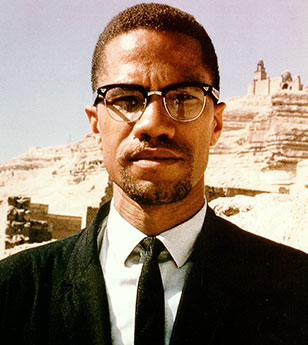
Malcolm X


Malcolm X


February is Black History Month, and I would be remiss if I didn’t take the opportunity to publicly acknowledge my all-time favorite civil rights leader. I first got to know who Malcolm X was through Alex Haley’s biography, and later through the film adaptation directed by Spike Lee. As a younger, testosterone-fueled football player, I found myself identifying more with Malcolm’s aggressive approach to civil rights, especially in contrast to the peaceful Satyagraha methods championed by Dr. Martin Luther King Jr.

But what I truly came to appreciate was the transformation of Malcolm X. I’ve always been drawn to stories of personal growth and the evolution of human character—and that’s exactly what you see in Malcolm’s life. His persona changed significantly over time. He was a burglar, then a prisoner, then a devout Muslim who preached separatism, and finally someone who came to see the beauty in all races and began preaching racial reconciliation.

Too often, we remember only the fiery rhetoric of Malcolm X and forget that his message had evolved by the time of his tragic assassination.

Malcolm converted to Islam during his time in prison, and upon his release, quickly rose through the ranks to become a leader in the Nation of Islam here in the United States. His first transformation was from a burglar to a devout Muslim leader who took an extreme stance on civil rights. His second transformation came during his pilgrimage to Mecca, where he prayed alongside Muslims of many races and realized that racial harmony was indeed possible.

The human character is a fascinating thing. We must remember that we can grow, change, and become enlightened as we continue through life, learning from those around us. This is what some psychologists refer to as a “growth mindset.” That’s exactly what happened to Malcolm. His story is a powerful testimony to the transformative power of love—something that can change all of us for the better.

So during the month of February, I choose to remember Malcolm X not only for his passionate voice and powerful rhetoric, but also for the transformation of his spirit, which ultimately led him to believe that racial reconciliation was possible.